Alpha · Manifold-led
SerpenOps
Keep intelligence moving at the edge — including when the network that was supposed to carry it is the thing that failed.
SerpenOps holds satellite and terrestrial links, ground-node health, and field conditions as one operating picture. Most coordination software assumes connectivity and degrades unpredictably without it. SerpenOps treats degraded connectivity as the normal operating condition rather than an exception to handle later.
Composed from
Manifold · Cortex
The same Twin Sync module that reconciles asset state in PRODIGY reconciles link conditions here. View the module layer →
§ 01
Ground network
A node that is down says it is down.
Each ground node carries its state, coverage radius, connected users, bandwidth utilisation, and the date it was last serviced. Online, degraded, and offline are three distinct states rather than a single health percentage.
A degraded relay running at 89% bandwidth for 92 users is a different operational problem from a tower that is simply off. Averaging them into one figure hides the decision.
For public operations →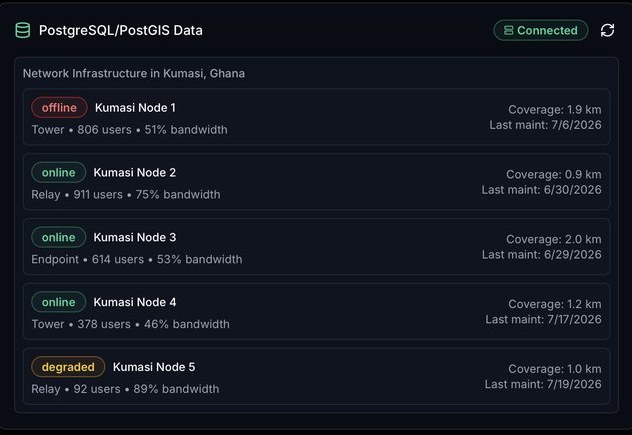
§ 02
Orbital availability
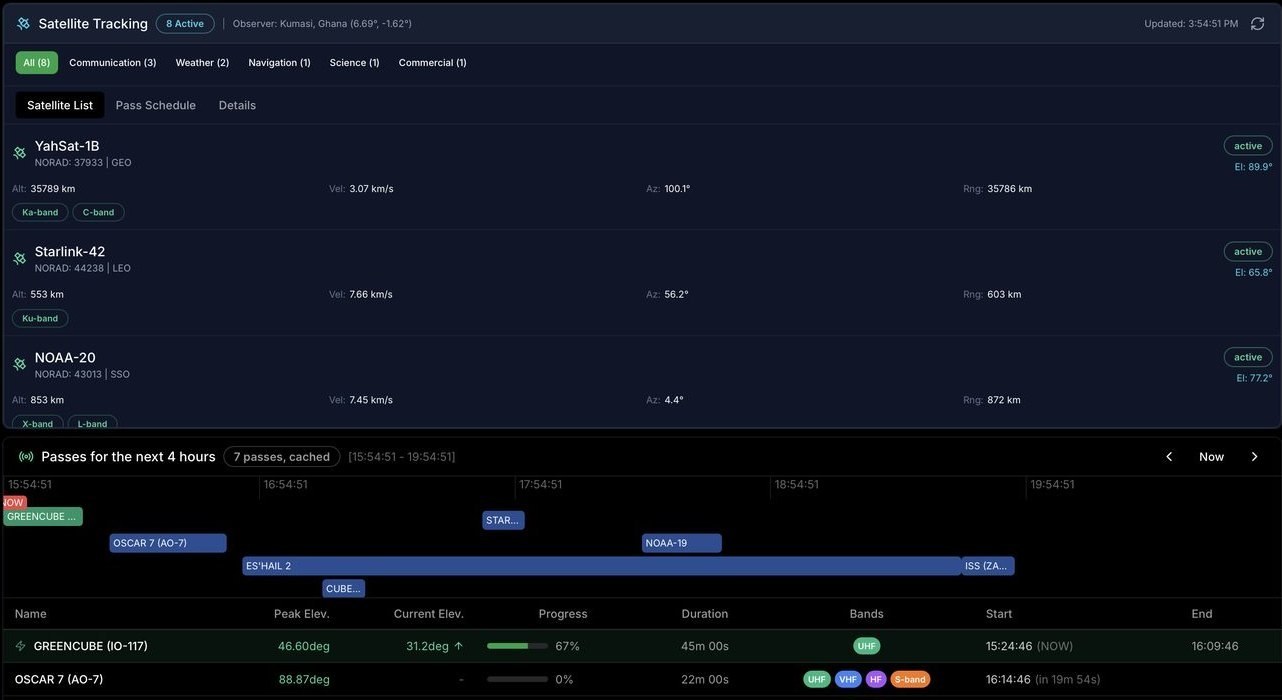
Windows you can plan against, from published orbital data.
Pass schedules, peak elevation, duration, and band allocation are derived from public orbital elements for a named observer position. When a window is projected rather than observed, it is labelled that way.
Serpens does not operate satellites and does not control any of the constellations shown. SerpenOps reads availability; it does not claim authority over the infrastructure it reads.
§ 03
Where it is pointed first
Kumasi, not a capital city.
The first environment is a region with genuine coverage gaps and real maintenance backlogs. A demonstration over dense, well-served infrastructure would look better and prove less.
Field operations
Teams working past the edge of reliable coverage, who need the picture to survive the gap rather than blank during it.
Network siting
Where the next node should go, argued from observed load and coverage rather than a vendor's propagation model.
Emergency response
Alongside PRODIGY, when the incident and the communications failure are the same event.
All powered by Serpens
Manifold · Cortex
Every Serpens product is a configuration of the same four engines and a shared set of reusable modules. How Serpens is built →