PRODIGY | Emergency & Infrastructure Operations | Serpens
Serpens Inc.
Apps ↗ Talk to Serpens
← Systems

Alpha · Manifold-led

PRODIGY

One state-reconciliation engine. Three configurations, each written for a different buyer.

Agencies, property owners, and underwriters are all asking the same question — what is the actual state of this thing, and how confident are we? PRODIGY answers it once and configures the surface to the operator. Everything shown on this page runs in simulation mode against exercise data.

Composed from

Manifold · Cortex

None of these modules were written for PRODIGY alone — the drift detection behind Civic is the same module Global Health IQ uses on outbreak signals. View the module layer →

§ 01

Civic — Emergency Management

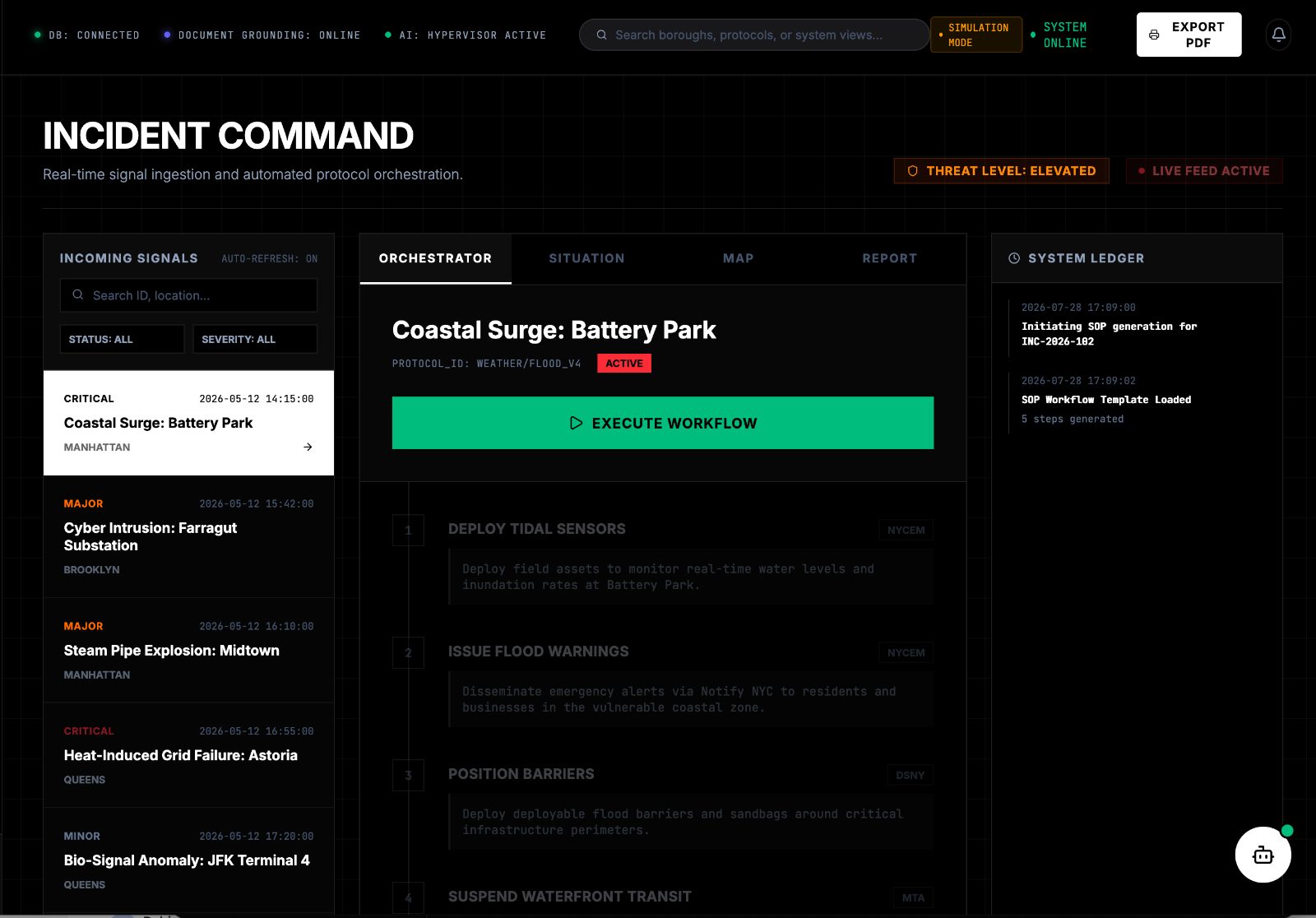
PRODIGY incident command: incoming signals ranked by severity beside a step-by-step protocol orchestration for a substation cyber intrusion.
Fig. 01Incident command — signals to protocol steps

The operating picture holds when four things break at once.

Signals arrive from across a city and resolve into ranked incidents. Each one carries a protocol — the actual sequence, with the responsible agency named on every step. The ledger records what was generated, when, and from which template.

Buyer

Municipal emergency management directors · state OEM · public infrastructure command

Emergency Management solution →

§ 02

The tabletop generator

Describe a compound crisis. Get a running exercise.

An operator types the scenario in plain language — coastal storm, substation failures, extreme heat, a simultaneous cyber intrusion. PRODIGY returns a structured exercise: timed injects, the trigger and event for each, the expected action from every agency involved, and the learning objectives the exercise is designed to test.

  1. Inject 1 · T+00:45

    The SCADA blind spot

    Drainage pumps fail to engage via remote telemetry as tidal waters peak. Crews attempting manual operation are locked out of the local HMI, which now displays a ransom message.

    Expected action · Pivot to manual field overrides; reroute traffic without signal synchronization; triage the network intrusion.

  2. Inject 2 · T+02:15

    Communications degradation

    A lightning strike disables a primary microwave relay carrying municipal radio, while a denial-of-service attack halts outbound emergency alerts to the blackout zones.

    Expected action · Stand up interoperable comms; fall back to runners and satellite phones; canvass door to door.

  3. Inject 3 · T+04:00

    The generator threshold

    A Tier-1 cooling center loses its backup generator to a corrupted fuel-pump controller. Internal temperature reaches 98°F with 150 vulnerable residents inside.

    Expected action · Dispatch transport with auxiliary cooling or evacuate; prioritize feeder restoration against competing demands.

Exercise scenarios are generated against simulated conditions and are not drawn from any live agency deployment.

§ 03

Asset Twin & Risk Ledger

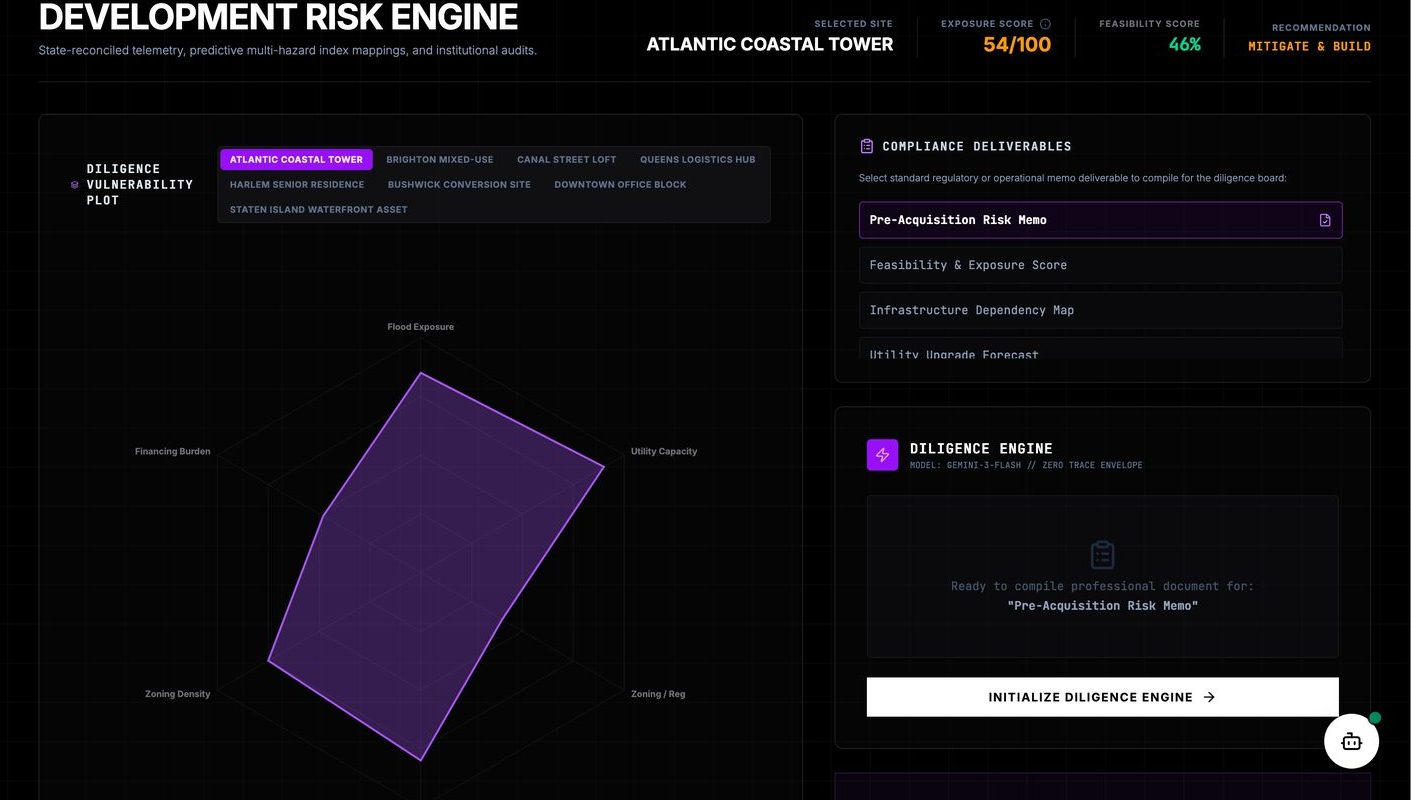
PRODIGY Asset Twin scoring a development site at 54 exposure and 46 percent feasibility across flood, utility, zoning and financing axes.
Fig. 02Asset Twin — exposure, feasibility, recommendation

Configuration · Built environment

Asset Twin

Feasibility, structural capex, and acquisition diligence for developers and property boards. The same reconciliation engine pointed at a building instead of a city — what the model predicts, what the sensors observe, and where the two have drifted apart.

Built Environment →
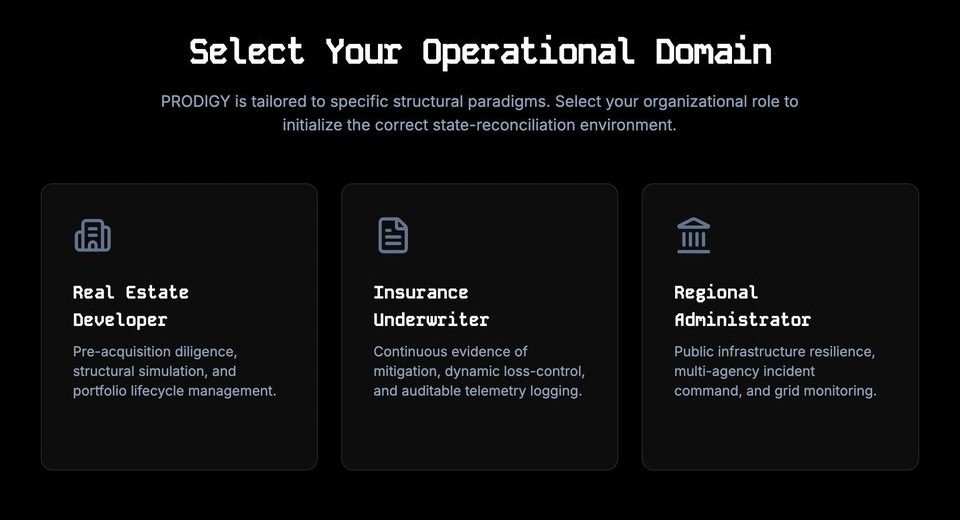
PRODIGY role gate asking the operator to select an operational domain: real estate developer, insurance underwriter, or regional administrator.
Fig. 03One engine, three profiles at entry

Configuration · Underwriting

Risk Ledger

Portfolio evidence for MGAs, captives, and reinsurance. Loss control and compliance trails built from the same reconciled state, so an underwriting file and an operations file describe the same asset rather than two versions of it.

Underwriting & Risk →

§ 04 — The engagement

Start with one exercise, not a procurement.

A Risk Intelligence Sprint runs ten days against one scenario you choose. You keep the generated exercise whether or not anything follows it.

  1. Week 1 Pick the scenario. Map the agencies and the decision points.
  2. Week 2 Run the exercise against your own asset and incident data.
  3. Gate Continue to a paid pilot, expand, or stop. A real decision either way.

All powered by Serpens

Manifold · Cortex

Every Serpens product is a configuration of the same four engines and a shared set of reusable modules. How Serpens is built →