Government Software for Public Operations | Serpens Inc.
Serpens Inc.
Apps ↗ Talk to Serpens

Public sector

Software for public operations.

Serpens builds operational systems for agencies responsible for public health, emergency response, infrastructure, data, and increasingly AI-enabled operations.

We are designed to work alongside existing systems of record and agency infrastructure — not to require an institution to replace them. Serpens reconciles what is happening, preserves the evidence behind what is known, controls what intelligence may access, and keeps human authority over consequential action.

§ 01

Mission areas

Emergency management

Coordinate compound incidents from a shared operating picture.

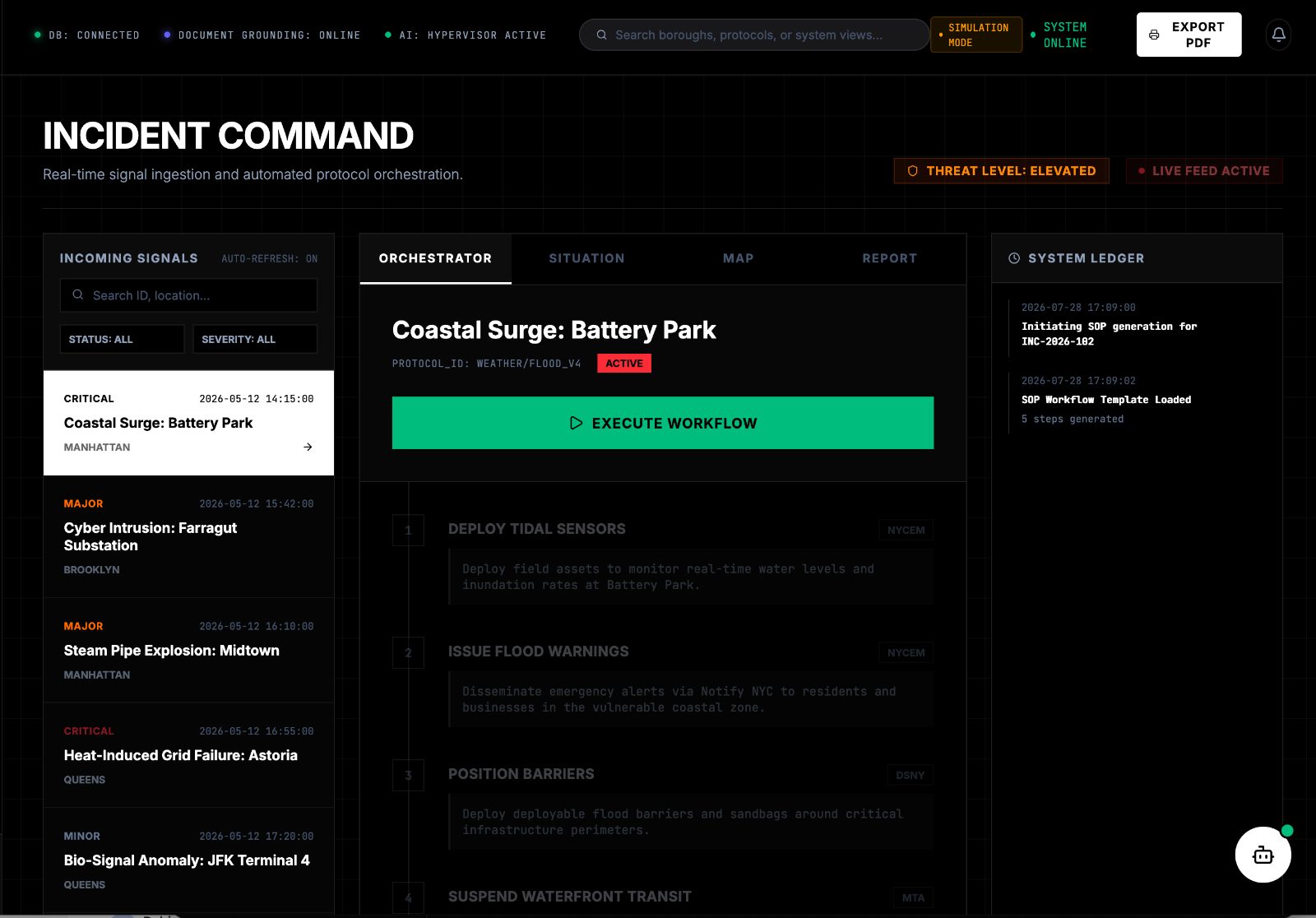
PRODIGY reconciles incoming signals, operational state, predicted conditions, and response procedures into a shared incident view. Simulation and exercise environments allow teams to test compound scenarios without presenting exercise data as a live deployment.

Relevant systems
PRODIGY Civic · Manifold
Relevant modules
Twin Sync · Evidence Ledger · Governed Autonomy · Spatial Intelligence
Explore emergency management →
PRODIGY incident command view reconciling incoming signals into ranked incidents with a responsible owner on each step.
Fig. 01Shared incident view · exercise data
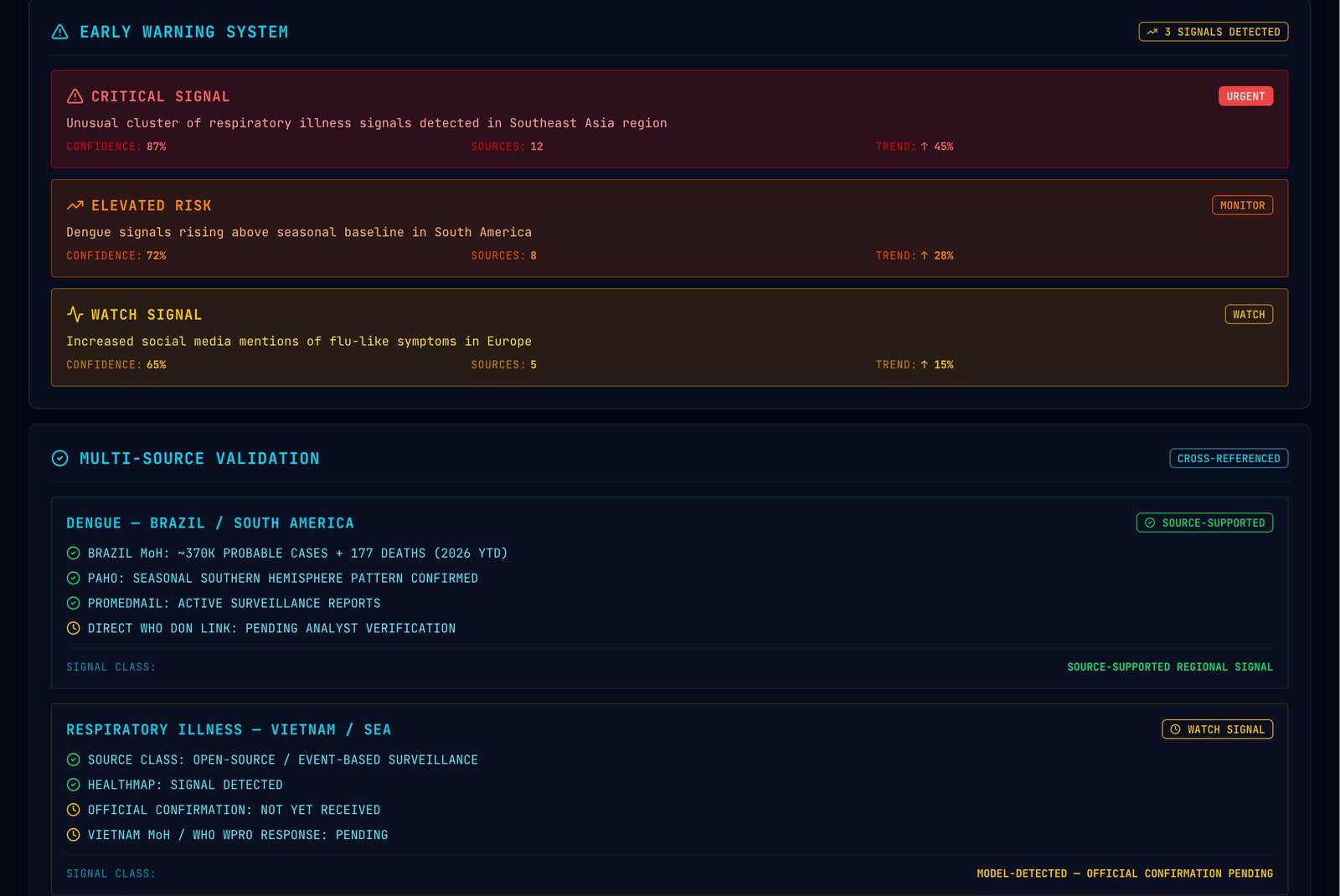
Global Health IQ multi-source validation showing which agencies corroborate a signal and which confirmations have not yet arrived.
Fig. 02Source class and corroboration kept distinct

Public health

Separate emerging signals from confirmed evidence.

Global Health IQ brings official, academic, humanitarian, and other monitored sources into one evidence structure while keeping risk, confidence, source class, and corroboration distinct.

An emerging signal can be operationally important without being presented as confirmed.

Relevant system
Global Health IQ
Relevant modules
Signal Firewall · Evidence Ledger · Multi-source Validation
Explore public health →

Infrastructure & assets

Reconcile the model with what the infrastructure is actually doing.

Manifold and PRODIGY combine asset state, telemetry, spatial conditions, inspections, simulations, and operator input while explicitly identifying disagreement between them.

The result is not simply a digital representation of an asset. It is a record of which state is authoritative, where uncertainty remains, and what changed.

Relevant systems
PRODIGY Asset Twin · Manifold
Explore infrastructure →

Connectivity & field operations

Maintain operational visibility under degraded connectivity.

SerpenOps combines terrestrial and satellite observations with field and network state to support operations where connectivity is intermittent, constrained, or changing.

Orbital availability and link conditions are treated as observed inputs where available — not as evidence of control over third-party infrastructure.

Relevant systems
SerpenOps · SerpenSky
Explore connectivity →

Government operations & knowledge

Turn institutional records into operational context.

Intelligence Hub and Cortex can connect policies, plans, contracts, reports, procedures, research, and other institutional records into a governed knowledge environment where generated conclusions retain their source.

Relevant modules
Evidence Ledger · Problem Definition Studio · Signal Firewall
Explore knowledge & research →

Governed AI operations

Use AI without surrendering operational authority.

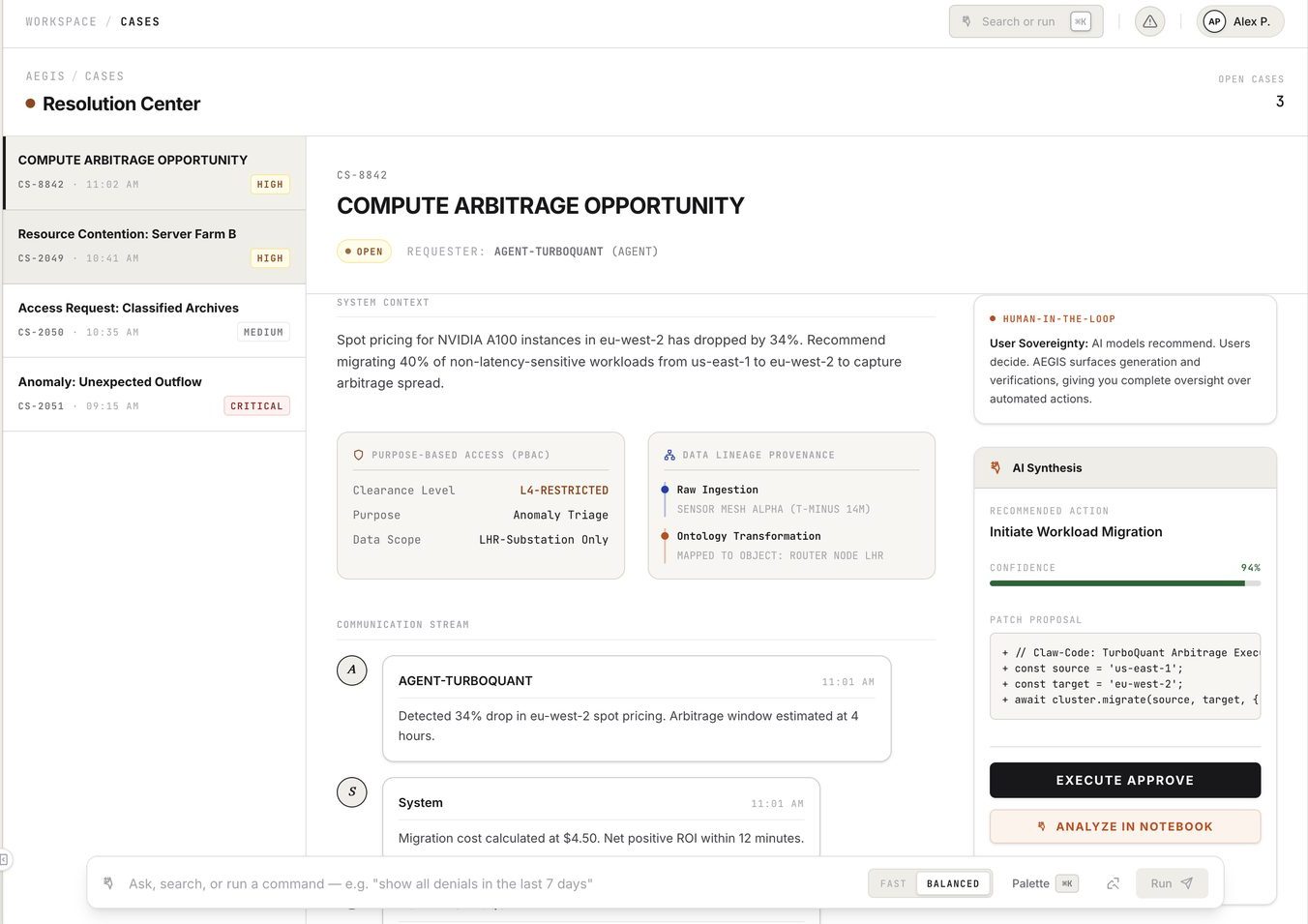
Aegis Work OS provides the operator surface for agent activity: what ran, what data it accessed, what it recommended, what requires approval, what was rejected, and what evidence supported the decision.

Aya reasons over the environment. Vault defines the permissible data boundary. Work OS gives the operator control over what becomes action.

Relevant systems
Aegis Work OS · Aya · Vault
Explore Work OS →
Aegis Work OS resolution centre showing agent activity, clearance, data lineage and the approval an operator must give before execution.
Fig. 03Agent activity, clearance, lineage, approval

§ 02

Where Serpens fits

One layer across fragmented operational systems.

Public institutions already have databases, feeds, procedures, sensors, vendors, records, and people with authority. The problem is usually not the absence of another system.

It is that those systems do not share the same operational state.

Manifold

Operational state

Reconciles observed, predicted, simulated, and operator-confirmed conditions across physical systems.

Cortex

Evidence

Separates sources, signals, inference, and generated intelligence while retaining provenance.

Vault

Permission and persistence

Defines what a system may access, where information remains, and what may be retained or shared.

Aya

Reasoning and orchestration

Coordinates analysis and agents while keeping approval, escalation, and reasoning visible to operators.

Serpens does not replace agency authority. It gives that authority a more coherent operational picture.

§ 03

How Serpens deploys

Scoped operational evaluation

Start with one bounded problem.

A Mission Sprint is the Serpens structured evaluation model. Before a system is configured, both sides establish six things in writing.

  1. 01 — Mission scope

    The operational question and the intended users.

  2. 02 — Data boundary

    What information may be accessed, where it may reside, and what may be retained.

  3. 03 — Authority

    Which actions are analytical, which require human approval, and which are out of scope.

  4. 04 — Acceptance criteria

    What evidence would demonstrate that the system is useful.

  5. 05 — Evaluation environment

    Simulation, representative data, or authorized operational data as appropriate to the engagement.

  6. 06 — Decision

    Continue, modify, expand, or stop.

A Mission Sprint does not bypass an agency's procurement, security, or data-governance requirements. It gives the engagement a bounded technical and operational scope once the appropriate pathway is established.

§ 04

What the agency receives

  1. Configured environment The relevant Serpens system configured against the agreed use case and data boundary.
  2. Evidence package Sources, transformations, system outputs, assumptions, and provenance captured during the evaluation.
  3. Operational artifact Depending on the mission: an exercise, operating picture, risk register, analysis, workflow, decision-support tool, or implementation plan.
  4. Evaluation memorandum What worked, what did not, observed limitations, the recommended next step, and whether expansion is warranted.

§ 05

Procurement & readiness

Current public-sector posture.

Contract vehicles

Not currently held.

Certifications

Only completed certifications are represented as such. Current security posture is maintained in the Trust Center.

Public deployment references

Simulation, demonstration, and reference environments are identified as such. Named operational references are published only when disclosure is authorized.

Data handling

Defined per engagement before access is granted.

Procurement pathway

Established before work begins, based on the agency and the engagement requirements.

Security review

Supported with current architecture, data-handling, dependency, and sub-processor documentation as available.

View Trust Center →

Bring us an operational problem, not an AI use case.

If Serpens is relevant, we will identify the minimum configuration required to evaluate it.

If the problem does not require Serpens, that should become clear before a large implementation begins.